
LogoSky at MRO Middle East: Aircraft Placards and Decals in Operational Context
Held annually in Dubai, MRO Middle East has become a consistent meeting point for the maintenance and engineering community across the Middle East and adjacent regions. The 2026 edition once again gathered airlines, MRO organisations, OEMs, and specialised suppliers operating within active fleet environments.
The operational nature of the event was evident throughout the exhibition floor and conference sessions. Discussions centred on aircraft availability, regulatory compliance, turnaround efficiency, and supply continuity rather than product presentation. Within this context, aircraft placards and decals were frequently addressed as regulated aircraft components installed on aircraft in service.
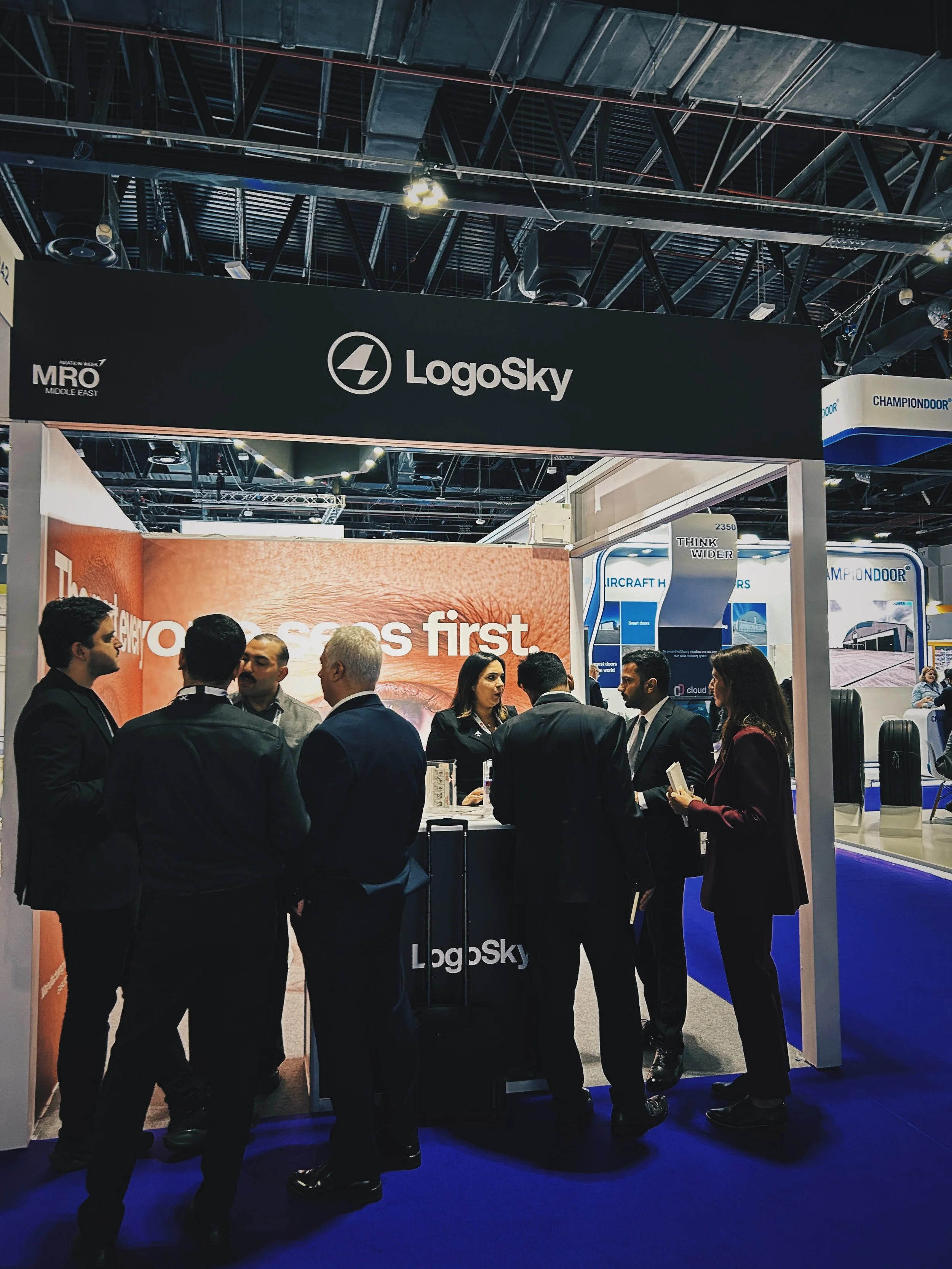
For LogoSky, participation involved reconnecting with established partners while also establishing numerous new technical contacts. The event reflected a visible increase in regional aviation activity, particularly in fleet expansion, cabin refurbishment projects, and heavy maintenance planning. These developments continue to influence demand for aircraft placards and markings across both scheduled and unscheduled maintenance environments.
Aircraft Placards and Decals: Defined by Function
Technical discussions at MRO Middle East repeatedly highlighted the functional distinctions between aircraft placards, decals, markings, and liveries. Operators and maintenance planners often approach these categories separately due to their regulatory and operational implications. Aircraft placards remain primarily interior safety and instruction labels supporting crew and passenger awareness.
Aircraft exterior placards and markings fulfil regulatory and technical requirements, including safety zones, servicing guidance, and structural identification. Aircraft decals typically refer to smaller exterior graphics such as registrations and technical texts, while aircraft liveries represent large-scale exterior identity graphics subject to controlled production and installation standards.
These distinctions were frequently referenced during maintenance planning conversations at the event, particularly when placard replacement during heavy checks. Material selection, adhesion performance, and durability considerations vary significantly across these categories, reinforcing the need for specialised manufacturing approaches.
Production Under EASA Part 21G
Within event discussions, approval status and traceability remained recurring themes. LogoSky operates as an aviation graphics manufacturer under an EASA Part 21G-approved production organisation, ensuring controlled production, documented conformity, and release procedures. Aircraft placards, aerospace decals, aircraft exterior placards, and aircraft liveries are manufactured entirely in-house within this framework.
Design data management, material traceability, and final inspection documentation form integral elements of the production process. Operators attending MRO Middle East frequently emphasised the importance of traceable production for aircraft placards and decals, particularly in multi-fleet environments where documentation consistency affects maintenance planning and regulatory audits.
Capability and Custom Production
Fleet diversity and ageing aircraft populations were recurring themes observed at MRO Middle East. Maintenance teams highlighted the need for both legacy placard support and newly introduced aircraft marking requirements. With a capability that exceeds 45,000 individual part numbers, LogoSky supports a broad spectrum of aircraft placards and markings across various aircraft types.
Where reference parts are unavailable, custom aircraft placards and aircraft decals can be produced using approved design data, dimensional references, or physical samples. Exterior placard kits for aircraft were also discussed as practical solutions during repaint events and fleet transitions. Consistency remains essential. Placards replaced during maintenance must replicate the original specifications in terms of typography, dimensions, and material behaviour to maintain fleet standardisation.
Installation Within a Controlled Framework
Installation considerations were frequently raised during technical conversations at MRO Middle East, particularly regarding repaint hangar coordination and turnaround limitations. Manufacturing aircraft placards and decals represents only one stage of the lifecycle. Installation conditions, including surface preparation, environmental exposure, and curing time, directly influence long-term durability and compliance.
LogoSky maintains dedicated installation teams integrated into its controlled production structure. This alignment reduces deviation between manufactured aircraft graphics and applied markings while supporting repaint programmes and maintenance schedules discussed at the event.
Operational Observations from MRO Middle East
Across meetings and technical exchanges, several operational priorities emerged: predictable lead times, supply repeatability, documentation clarity, and responsiveness during AOG scenarios. Aircraft placards and decals often become time-critical components during heavy checks. The event provided insight into how maintenance planners approach aerospace decals, aircraft exterior placards, and exterior placard kits for aircraft as part of broader fleet management strategies.
Increased regional activity observed during MRO Middle East suggests continued demand for regulated aircraft placards and markings supporting both scheduled maintenance and fleet modernisation programmes. MRO Middle East continues to provide a focused forum where aircraft placards, aerospace decals, aircraft exterior placards, and aircraft liveries are discussed as operational aircraft components requiring controlled production, traceability, and precise installation.