Five Aircraft, Four Locations: Engineering Aircraft Livery for Operational Use
An aircraft livery is the visible result of a detailed technical process. Before the first graphic reaches the airframe, approved artwork must be adapted to aircraft geometry, divided into controlled production sections and checked against doors, windows, access panels, structural features and other installation references. Material compatibility, colour consistency, surface conditions and available ground time must also be considered before production begins.
LogoSky’s recent projects across Spain, Türkiye and Belgium demonstrate how this process changes between aircraft types, visual concepts and operational environments. From campaign graphics for Vueling and Air Europa to widebody identity applications for Siamwings and Air Atlanta, each programme required an individual production and installation approach. Several of these projects also continue established working relationships, showing how technical familiarity and consistent production standards support successive aircraft programmes over time.
As an EASA Part 21G Approved Production Organisation and aviation graphics manufacturer, LogoSky manages these requirements through controlled production, documented traceability and configuration-based manufacturing. The objective is not only to reproduce the approved design, but to manufacture an aircraft livery that can be installed accurately and perform reliably in its intended operating environment.
From Approved Artwork to Aircraft Surface
Artwork developed for a screen or presentation cannot be transferred directly to an aircraft at full scale. The design must first be assessed against the actual airframe, including fuselage curvature, panel transitions, window lines, doors and maintenance access areas. Reference points are then established so that each section can be positioned consistently during installation.
The production file must also account for overlaps, joining points and the sequence in which the graphics will be applied. On larger designs, small dimensional inconsistencies can become highly visible once multiple sections meet across the fuselage. Accurate engineering preparation therefore has a direct effect on both installation time and the final appearance of the aircraft.
This method formed the basis of the five recent projects featured here. Although each aircraft carried a different visual identity, all were managed through the same disciplined connection between technical preparation, controlled manufacture and on-site installation.
Dream, Play, Fly: Turning Creative Artwork into Aircraft Graphics
The Vueling “Dream, Play, Fly” project, completed in Castellón, Spain, transformed an Airbus A320 into a large-scale visual platform for the airline’s partnership with FC Barcelona Women. This was not the first aircraft produced for the collaboration. It marked the third livery completed as part of the continuing Vueling–Barça Femení partnership, with LogoSky supporting Vueling as the production partner from the beginning of the programme.
The design combines player imagery, typography and strong colour fields across a substantial part of the fuselage. Converting these elements into a production-ready plane livery required more than enlarging the original artwork. Image quality, colour transitions and graphic proportions had to remain consistent after scaling, while each section had to correspond with the geometry of the aircraft.
The team incorporated doors, windows, panel lines, and other airframe features into the preparation process so the main visual elements remained continuous after installation. Production planned segmentation to support accurate on-site positioning and reduce unnecessary adjustment during the available application window.
The completed aircraft livery is expressive and highly visible, but the result depends on controlled work behind the surface: data review, graphic engineering, material selection, colour management, manufacturing and installation planning operating as one coordinated process.
A Continuing Partnership with Vueling
LogoSky also completed another Vueling aircraft livery programme in Castellón. Its cleaner, brand-led composition created a very different technical requirement from the image-intensive “Dream, Play, Fly” design. The repeated programmes reflect an established production relationship in which each new aircraft is treated as an individual technical project rather than a reproduction of the previous application.
Large typography and geometric elements expose even minor alignment or proportion errors. Their apparent simplicity means that spacing, orientation and continuity must be controlled precisely across the fuselage. The graphic sections must integrate with the airline’s existing identity while maintaining the approved relationship between colours, forms and aircraft features.
The continuing work with Vueling demonstrates why an aircraft livery maker cannot rely on one standard application method. Even when projects involve a similar aircraft type and the same installation location, the artwork determines how files are prepared, how sections are manufactured and how the installation sequence is planned.
Long-term cooperation provides familiarity with the operator’s visual standards and working requirements, while every new design still requires its own dimensional review, production planning and installation controls.
Widebody Geometry for Siamwings
The Siamwings project in Antalya, Türkiye, continued an existing working relationship with LogoSky. Having previously completed livery work for Siamwings, the latest programme brought the scale and compound geometry of an Airbus A330 back into the production and installation process. The identity is defined by a strong red tail treatment, a white wing motif and corresponding fuselage elements.
On a widebody aircraft, the physical scale of the surfaces changes the way graphic dimensions and installation references must be managed. Tail graphics extend across curved areas where distortion can occur if the artwork is not adapted correctly. Fuselage markings must also maintain their visual balance when viewed from different distances and angles.
For this repeat project, the airframe and installation conditions were evaluated again as part of the production preparation. Previous experience with the operator supported continuity, but it did not replace aircraft-specific verification.
The result shows how a limited number of graphic elements can establish a clear airline identity when shape, proportion, placement and colour output are controlled throughout the programme.
Large-Format Identity on the Air Atlanta Boeing 747
In Liège, Belgium, LogoSky completed exterior identity graphics for an Air Atlanta Boeing 747. The operator’s blue and gold tail graphic was applied to one of the industry’s largest and most recognisable aircraft profiles.
The vertical stabiliser of a Boeing 747 creates specific production and access requirements. Its height, surface curvature and overall scale influence graphic sectioning, lifting access, reference positioning and application sequence. Large-format aerospace decals must be produced in manageable sections without creating visible disruption in the completed identity.
The operational context is equally important. On cargo aircraft, the installation programme must fit within the available ground window and coordinate with other work taking place around the aircraft. Manufacturing accuracy reduces the need for modification during application and supports a more predictable installation process.
Maintaining Detail Across the Air Europa El Salvador Livery
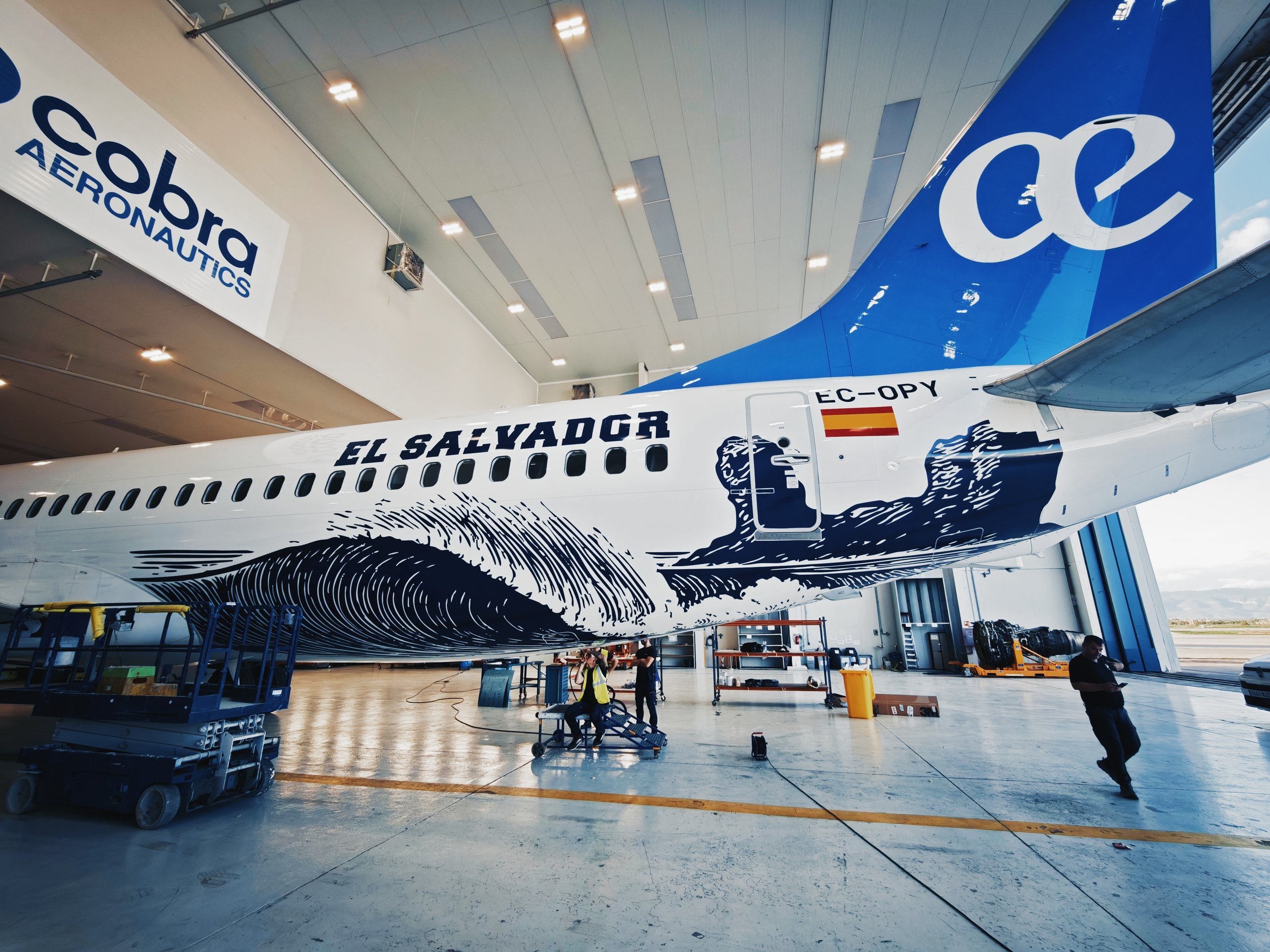
The Air Europa “El Salvador” aircraft livery, completed in Mallorca, Spain, required detailed illustrative graphics to be transferred across the fuselage. The design combines destination lettering, tonal artwork and large visual elements to turn the aircraft surface into a narrative composition.
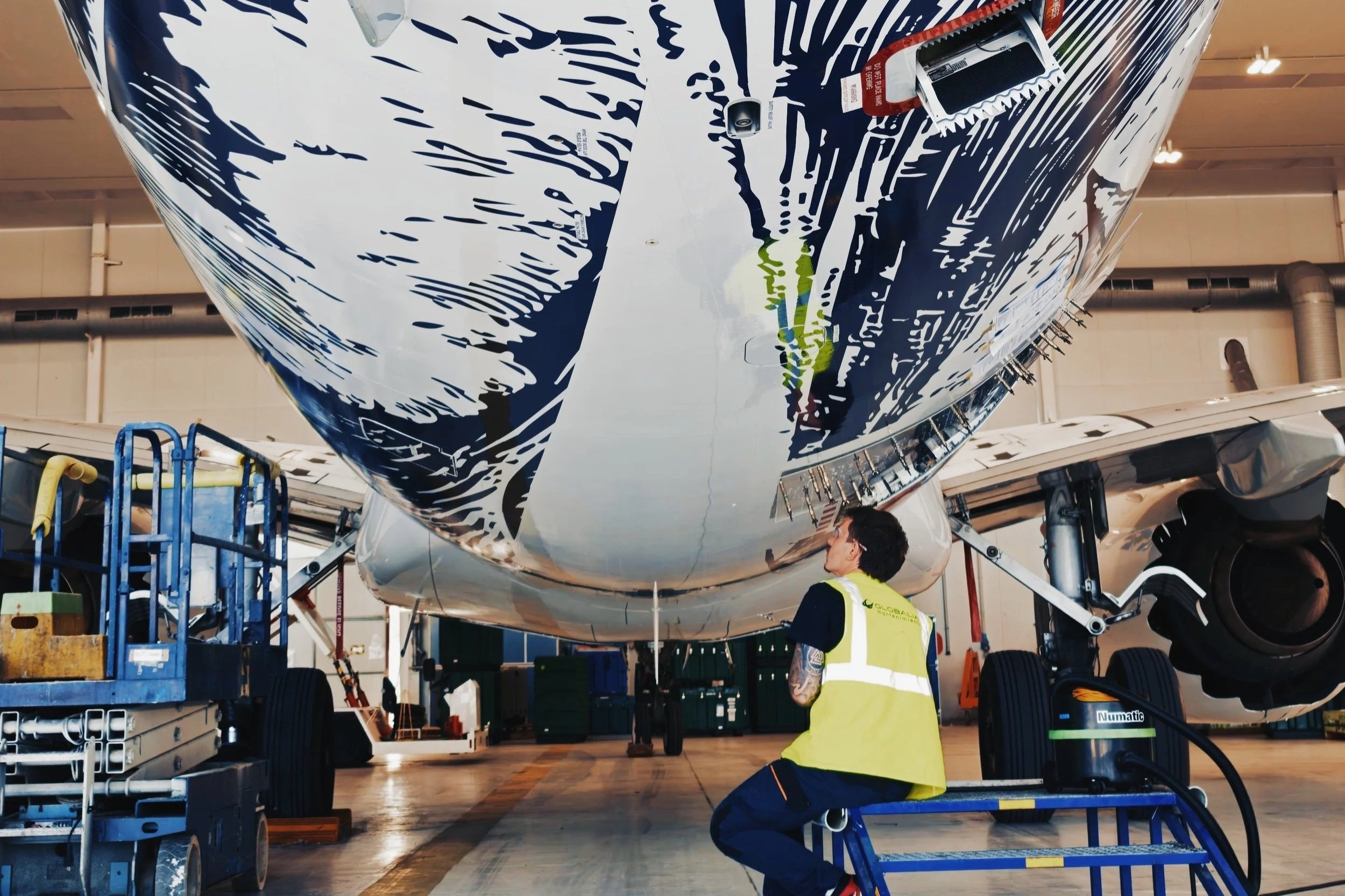
Illustrative liveries introduce different production controls from conventional airline identity graphics. Fine detail must remain legible after enlargement, tonal transitions must remain consistent across separate print sections and the complete image must align after installation. Doors, windows and structural breaks must be considered during file preparation so that they do not interrupt essential parts of the artwork.
Colour control is particularly important when multiple sections form one continuous image. Each part must be manufactured under consistent output conditions so that the final aircraft does not show unwanted variation between adjoining panels.
The completed Air Europa project demonstrates how detailed creative artwork can be converted into a technically structured and installable aircraft graphic system.
EASA Part 21G Control Behind Every Visible Result
Although these projects differ in aircraft type, scale and visual language, they depend on the same manufacturing principles. Artwork and aircraft data must be reviewed accurately, materials must be compatible with the intended surface and operating environment, and colour output must remain repeatable across the complete production run. Graphic sections must be prepared for practical installation, while part identification and production records must remain traceable throughout the process.
LogoSky is an EASA Part 21G Approved Production Organisation. As an EASA-approved aviation graphics manufacturer, we manufacture aircraft graphics in Istanbul through controlled processes designed to support production conformity, repeatability and documented traceability. CoC and EASA Form 1 documentation can be provided as applicable to the manufactured parts and project requirements.
Our in-house scope extends beyond complete livery programmes. It includes aircraft decals and placards, aircraft exterior placards, registration markings, flags, stencils, cabin graphics and technical identification products. Individual aircraft placard requirements can be manufactured alongside wider exterior programmes, supporting consistent part identification and configuration control.
LogoSky also provides metal engraving for durable identification plates and technical markings. These parts require accurate text, controlled depth, material-specific processing and long-term legibility. Bringing aircraft livery, aircraft placard and metal engraving capabilities within the same controlled manufacturing structure allows visual and technical identification requirements to be managed through a coordinated production approach.
Production and Installation as One Continuous Process
The technical decisions made during manufacturing directly affect the work carried out on the aircraft. Section dimensions, reference marks, overlap positions and application order must reflect the actual installation environment. Treating production and installation as disconnected stages can create avoidable adjustments, material waste and schedule pressure on site.
LogoSky carries out livery application with its own experienced installation teams rather than transferring the final stage to an unrelated subcontractor. This continuity provides direct feedback between production planning and application conditions. When an airframe measurement, surface feature or positioning detail requires verification, the information can be evaluated within the same technical workflow.
This is especially important for short ground windows, widebody aircraft and complex special liveries. Installation accuracy begins long before the team reaches the aircraft; it is established through the way the project is reviewed, engineered and manufactured.
The Engineering Behind the Finished Aircraft
The most visible moment in an airline livery programme is the aircraft leaving the hangar. By that stage, however, the decisions that determine the quality of the result have already been made.
The Vueling, Air Europa, Siamwings and Air Atlanta projects show how different creative objectives can be managed within a consistent technical framework. They also demonstrate the value of continuing customer relationships.
The third Vueling–Barça Femení livery and the renewed work for Siamwings reflect the confidence created through repeatable production, technical continuity and dependable execution. Some aircraft carry a partnership or destination story, while others establish or restore an operator’s fleet identity.
Each design requires its own engineering response, but every completed aircraft depends on accurate data, compatible materials, controlled manufacturing and coordinated installation.
For LogoSky, aircraft livery production is not simply large-format printing. It is the controlled conversion of approved visual data into an aircraft-specific graphic system, manufactured for accurate application, operational use and repeatable results.